
Oral and dental health is not only about aesthetic appearance but also an important part of our overall health. Crooked teeth not only affect your smile, but can also cause many problems such as gum issues, tooth pain, and difficulty chewing. Modern dentistry offers various orthodontic solutions to eliminate these problems. One of the most common questions we encounter is: braces or aligners?
In this article, we will help you determine the most suitable choice for you by comparing both methods in detail.
What are braces?
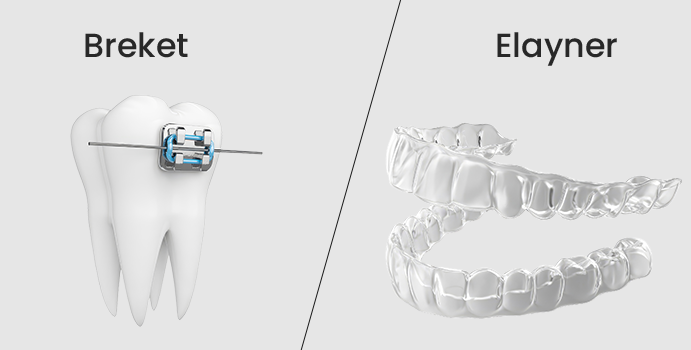
Braces are a classic orthodontic treatment method in which brackets are attached to the teeth and connected with a wire system. This system gradually moves the teeth into the correct position and shows high effectiveness even in the most difficult orthodontic problems. This method, which has been used for many years, is still considered one of the most reliable options in modern dental clinics.
Advantages of braces:
- Effective in difficult and complex dental problems.
- Provides full control over tooth movement.
- Ensures long-term and stable results.
- Different types are available such as metal, ceramic, and zircon.
Disadvantages of braces:
- May be visible from an aesthetic perspective
- Food particles accumulate more, may cause gum problems.
- Requires special attention to daily cleaning.
- May cause tooth pain and sensitivity in the initial stage.
What are aligners?
Aligners are transparent, removable orthodontic trays that are custom-made. These trays are replaced at certain intervals and gradually bring the teeth into the correct position. In recent years, they have become one of the most preferred solutions in modern dentistry in terms of aesthetics and comfort.
Advantages of aligners:
- Almost invisible.
- Can be removed, making eating and cleaning easier.
- Causes less tooth pain and discomfort.
- Easier to maintain gum health.
Disadvantages of aligners:
- May not be sufficiently effective in very complex cases.
- Requires use for 20–22 hours a day.
- Requires discipline (risk of removing and forgetting)
- May be more expensive in some cases.
Main differences between braces and aligners
- Aesthetic appearance:
Braces are visible, while aligners are almost unnoticeable. - Comfort:
Braces may cause tooth pain at the initial stage, aligners are more comfortable. - Hygiene:
Cleaning is difficult with braces, while it is easier with aligners. - Effectiveness:
Braces can be used in all cases, aligners are more suitable for mild and moderate cases.
When are braces more suitable?
Braces are mainly used in more complex orthodontic problems. If your teeth are severely crooked, if there are jaw structure problems, or if a major change in the position of the teeth is required, braces provide more effective results. Since this method offers full control over tooth movement, it is preferred in long and complex treatments. At the same time, it is considered a more reliable option in terms of stable and long-term results.
When are aligners more suitable?
Aligners are more ideal for individuals who seek aesthetics and comfort. If you have mild or moderate tooth misalignment and appearance is important in your daily life, aligners may be a more suitable choice. Thanks to their removable feature, maintaining oral hygiene becomes easier, which plays an important role in preventing gum problems. Especially for individuals with an active social life or those who care about appearance in the workplace, aligners are considered a more practical solution.
Which is better in terms of gums and tooth pain?
During orthodontic treatment, gum health requires special attention. When using braces, food particles accumulate more easily, which may increase the risk of gum inflammation. This can lead to tooth pain and other problems over time.
With aligners:
- Teeth are easier to clean
- Gums stay healthier
- Risk of inflammation decreases
However, if proper care is not taken in both methods, gum problems and tooth pain are inevitable.
What does modern dentistry say?
Modern dentistry has moved away from a standard approach and now provides individual planning for each patient. In other words, there is no “best method” — there is the most suitable method for you.
The doctor considers the following factors when making a choice:
- Condition of the teeth
- Jaw structure
- Age and lifestyle
- Aesthetic expectations
- Budget and treatment duration
Conclusion
When choosing between braces and aligners, the main issue is not only aesthetics but also long-term oral and dental health. If you have complex dental alignment problems, braces will provide more effective and stable results. If you are looking for a more comfortable, invisible, and practical solution in daily life, aligners may be the ideal choice for you.
Remember that the correct choice can only be determined through a professional dental examination. Starting treatment at an early stage both prevents gum problems and minimizes the risk of tooth pain.
Get one step closer to a healthy and aesthetic smile with Dentera!
If you are experiencing crooked teeth, gum problems, or frequent tooth pain, do not delay treatment.
At Dentera dental clinic:
- Personalized examination and planning
- Modern braces and aligner treatments
- Aesthetic and functional approach
Moreover, to make your treatment more accessible, we offer interest-free, no-guarantor, and no upfront payment options! Take the first step today for a healthy, straight, and aesthetic smile. Feel the transformation with Dentera!
FAQ – Frequently Asked Questions
- Is there a price difference between braces and aligners?
Yes, aligners are usually more expensive. However, many dental clinics now offer interest-free, no-guarantor, and no upfront payment options. - Is tooth pain normal when wearing braces?
Mild tooth pain and sensitivity may occur in the first days. This is related to tooth movement and is temporary. - Are aligners suitable for everyone?
No. Aligners may not be sufficiently effective in very complex orthodontic cases. - How long does the treatment take?
The duration varies depending on the condition of the teeth. On average, it can take from 6 months to 2 years. - Which is better for people with gum problems?
Aligners are more convenient in terms of hygiene. However, with proper care, braces can also be used safely.