
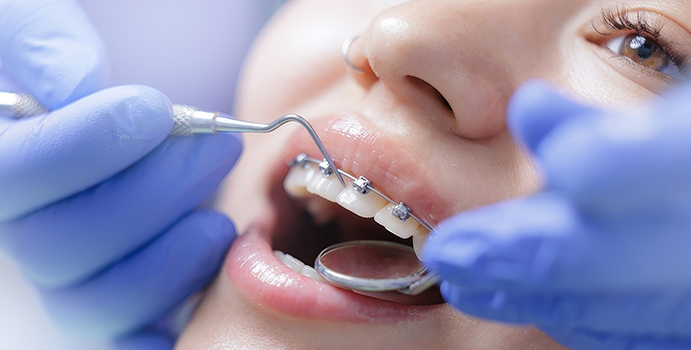
A healthy and aesthetic smile directly affects both a person’s appearance and their self-confidence. However, many people cannot smile comfortably due to crooked teeth, crowding, or bite problems. These problems are not only aesthetic but also create functional difficulties. For this reason, braces treatment is considered one of the most commonly used and effective methods in modern dentistry.
As a result of properly planned orthodontic treatment, it is possible not only to straighten teeth but also to improve overall oral health and achieve brighter teeth.
So, who should wear braces and how can this treatment help achieve a more correct and healthy smile?
What are braces and why are they so important?
Braces are an orthodontic system used to bring teeth into the correct position. This system allows teeth to gradually move through light but continuous pressure.
Many people see braces only as an aesthetic procedure. However, the main goals of this treatment are broader:
- To ensure proper alignment of teeth
- To restore chewing function
- To create even pressure on teeth
- To prevent dental and gum diseases
Food residues accumulate more in misaligned teeth, increasing the risk of decay. In such cases, delayed intervention may require more serious procedures such as root canal treatment. Therefore, solving orthodontic problems early is a more correct long-term choice.
One of the most common types of braces is metal-ceramic braces. This system applies planned and controlled pressure to the teeth, gradually bringing them into the correct position.
Who should wear braces?
Braces treatment is not only for teenagers. Today, people of all ages can benefit from it. The main indications are:
1. When teeth are crowded
If teeth overlap, it creates both aesthetic and hygienic problems. Such teeth are harder to clean, increasing the risk of decay.
2. When there are gaps between teeth
Spaces between teeth affect smile aesthetics and may sometimes cause gum problems.
3. When there is a bite problem
Improper alignment of upper and lower teeth may cause jaw pain, headaches, and difficulty chewing.
4. Crooked front teeth
Especially front teeth misalignment causes discomfort in social life and reduces self-confidence.
5. Jaw structure problems
In some cases, the issue is not only with teeth but also jaw development. In such cases, a more complex orthodontic approach is required.
6. Problems from childhood
Orthodontic issues that are not treated in time become more severe over time and prolong treatment.
Step-by-step braces treatment process
Braces treatment is not just about placing brackets. It is a structured and planned process:
1. Initial consultation and diagnosis
The doctor evaluates the condition of the teeth, and X-rays and other analyses are performed. At this stage, the duration and plan of treatment are determined.
2. Oral preparation
Before braces are applied, teeth must be completely healthy. If:
-there are decayed teeth
-there is nerve damage
treatment is performed first. In some patients, root canal treatment may be required. This stage is important to prevent future problems.
3. Braces placement
Special brackets are attached to the teeth and connected with orthodontic wires.
4. Active treatment phase
Teeth gradually move during this phase. The patient visits the doctor regularly, and adjustments are made.
5. Result stabilization
After teeth are aligned, retainers are used to maintain the result long-term.
Advantages of braces treatment
Braces treatment offers major advantages not only aesthetically but also in terms of health:
- More correct and functional alignment
- Improved chewing process
- Easier cleaning
- Reduced risk of gum diseases
- Long-term health
Most importantly, the achieved aesthetic smile and bright teeth significantly improve quality of life.
Is wearing braces painful?
Many people are afraid of braces because they think it is painful. In reality:
- Mild discomfort may be felt in the first days
- This feeling decreases within a few days
- Modern braces systems are more comfortable
So the process is not frightening, and the result is worth this minor discomfort.
How long does braces treatment take?
The duration varies individually. Main factors:
- Severity of the problem
- Age of the patient
- Compliance with treatment
Usually, braces treatment lasts from 6 to 24 months. In more complex cases, it may take longer.
Are braces enough for bright teeth?
Braces straighten teeth, but additional care is needed for ideal aesthetics:
- Daily proper brushing
- Using dental floss
- Professional cleaning
- Whitening procedures
After braces treatment, aesthetic procedures help achieve brighter teeth and a more attractive smile.
Don’t delay your smile!
Ignoring crooked teeth or bite problems may lead to more serious issues in the future. In advanced cases, treatment becomes more difficult and may require procedures such as root canal treatment.
Braces treatment started on time:
- Gives faster results
- Requires less intervention
- Provides longer-lasting effects
Take the first step for straight and bright teeth!
If you want a more aesthetic and healthy smile, Dentera is the right choice.
Whether it is braces treatment, root canal treatment, or aesthetic procedures — all can be obtained with interest-free, no-guarantor, and no down payment options.
FAQ – Frequently asked questions
- Is there an age limit for braces?
No. It can be applied to both children and adults. - Is braces treatment painful?
Mild discomfort may occur in the first days. - What should not be eaten with braces?
Very hard, sticky, and sugary foods should be avoided. - Do braces make teeth yellow?
No, if proper hygiene is maintained. - Can teeth become crooked again after braces?
Yes, if retainers are not used.